The AGP CONTROL™ Method
Keeping Leadership in Control of Artificial Intelligence
By Massimo Brebbia - 10 min read - Published 03 May 2026
Executive Summary
Artificial Intelligence is changing organisations at a pace few leadership teams have experienced before. Unlike previous technology transformations, AI is not waiting for formal approval, structured implementation programmes or enterprise-wide strategies. It is already being adopted by employees, embedded into software platforms, introduced by suppliers and increasingly influencing how work is performed across every business function.
For many organisations, this creates an uncomfortable reality. Leadership remains accountable for business decisions, regulatory compliance, client confidentiality and organisational performance, yet often has only limited visibility of where Artificial Intelligence is being used or how it is is influencing daily operations.
This is not a technology problem. It is a leadership challenge.
The question facing executive teams is no longer whether Artificial Intelligence should be adopted. In many cases, that decision has already been made by the organisation itself through hundreds of individual choices made every day by employees, managers, contractors and technology providers. The real challenge is ensuring that innovation develops within a framework that preserves accountability, protects organisational interests and enables leadership to remain in control.
The AGP CONTROL™ Method was developed to address that challenge.
Rather than treating AI governance as a compliance exercise or a technology project, the method provides leadership with a structured approach to understanding current AI use, establishing practical governance, enabling responsible adoption and maintaining executive oversight as the organisation evolves.
Its objective is straightforward.
To help organisations adopt Artificial Intelligence confidently, responsibly and without losing control.
1. Why AI Changes the Leadership Conversation
Every major technological advance has required organisations to adapt. The introduction of email transformed communication. Cloud computing changed the way businesses consumed technology. Mobile devices redefined how employees worked and collaborated. Artificial Intelligence is different because it is capable of influencing how people think, analyse information and make decisions.
For the first time, technology is not simply supporting work; it is beginning to contribute to knowledge work itself.
Employees are asking AI to draft reports, analyse spreadsheets, review contracts, prepare presentations, summarise meetings and generate software code. Marketing teams are creating campaigns in minutes rather than days. Engineers are using AI to explore technical solutions. Human Resources departments are drafting policies and job descriptions with AI assistance. Customer service teams are using intelligent assistants to respond more quickly to enquiries.
None of these developments is inherently negative. On the contrary, many represent genuine improvements in productivity and efficiency. Organisations that fail to embrace Artificial Intelligence will almost certainly struggle to remain competitive in the years ahead.
The challenge is not adoption; the challenge is adoption without visibility.
Unlike previous technology initiatives, AI rarely enters an organisation through a single programme managed by the IT department. It appears gradually. One employee experiments with a public AI platform to improve a report. A business unit purchases a specialist AI application to solve a local problem. A software vendor quietly introduces AI functionality into an existing platform. A supplier begins using AI to deliver part of a contracted service without changing the service description.
Each decision appears reasonable when viewed in isolation.
Collectively, they can transform the way an organisation operates long before executive leadership recognises that such a transformation has taken place.
This is why Artificial Intelligence should not be viewed solely as a technology initiative. It is a leadership issue because leadership remains accountable for every decision, every process and every outcome influenced by AI, regardless of where that AI originated.
Understanding that distinction is the first step towards effective governance.
2. The Invisible AI Governance Gap
Every executive relies on visibility.
Financial decisions depend on accurate financial reporting. Operational decisions depend on reliable performance information. Strategic decisions depend on understanding the organisation's current position before deciding where it should go next.
Artificial Intelligence should be no different.
Yet many organisations have comprehensive visibility over their financial assets, physical assets and information systems while having only a partial understanding of how AI is being used across the business.
Leadership may know which enterprise AI platforms have been approved, but not which public AI tools employees access every day. They may know which technology projects include AI, but not whether suppliers are using AI while processing confidential information or delivering critical services. They may understand their cybersecurity risks yet remain unaware that commercially sensitive data is routinely being entered into publicly available AI platforms.
This difference between perceived control and actual visibility is what we describe as the AI Governance Gap, and it is rarely created through negligence.
More often, it is the natural consequence of technology evolving faster than organisational governance.
Employees are not trying to bypass management. They are trying to become more productive. Managers are not deliberately avoiding governance. They are solving business problems with the tools available to them. Software providers are continuously embedding AI capabilities into existing products because their customers expect innovation.
The organisation evolves one decision at a time until leadership eventually discovers that Artificial Intelligence has become part of everyday operations without ever being managed as an organisational capability.
The greatest risk is not that AI exists within the organisation.
The greatest risk is believing that its use is fully understood when it is not.
That is where governance must begin—not with technology, but with visibility.
3. Why Existing Governance Is No Longer Enough
Most organisations already have governance. They have policies governing information security, procurement, cybersecurity, legal compliance, quality management and operational risk. These systems have often been refined over many years and continue to provide an effective framework for managing traditional business activities.
The challenge is that Artificial Intelligence does not behave like traditional technology.
Historically, new technology entered an organisation through a relatively structured process. A business need was identified, a procurement exercise was completed, technical assessments were performed, budgets were approved, systems were implemented and users were trained. Governance naturally followed the same sequence because technology adoption itself was predictable.
Artificial Intelligence has disrupted that model.
Today, an employee can register for a powerful AI platform in less than five minutes. A department can purchase a specialist AI application using a corporate credit card without involving central IT. A software supplier can introduce AI functionality into an existing application as part of a routine software update. An external contractor may rely extensively on AI to deliver work on behalf of the organisation without ever mentioning it in the contract.
None of these situations necessarily breaches existing policies, because many policies were written before these scenarios became commonplace. Governance frameworks designed for conventional software procurement were never intended to monitor thousands of independent decisions about how Artificial Intelligence is used throughout an organisation.
This explains why many leadership teams believe governance already exists while simultaneously feeling uncertain about the organisation's actual exposure.
The governance framework itself is rarely the problem.
The problem is that Artificial Intelligence introduces new questions that traditional governance was never designed to answer.
Can confidential information be entered into a public AI platform?
Should every AI application be approved before employees use it?
How should AI-generated work be verified before it influences an operational or commercial decision?
If an AI system produces an incorrect recommendation that contributes to a business loss, where does accountability remain?
Should suppliers disclose when Artificial Intelligence forms part of the services they provide?
What level of transparency should clients reasonably expect when AI contributes to work delivered on their behalf?
These are not purely technical questions. They involve legal obligations, commercial relationships, operational decision-making, organisational culture and executive accountability. Answering them requires collaboration across the organisation rather than responsibility resting solely with one department.
This explains why AI governance should not be viewed as an extension of cybersecurity or information technology. Those disciplines remain essential, but Artificial Intelligence reaches far beyond technology. It influences how decisions are made, how information is interpreted, how services are delivered and ultimately how leadership fulfils its responsibilities.
The organisations that will succeed over the coming decade are unlikely to be those that adopt Artificial Intelligence the fastest. They will be those that integrate AI into existing business governance without losing transparency, accountability or trust.
Achieving that balance requires a different way of thinking.
It requires a method rather than a collection of isolated controls.
The AGP CONTROL™ Method
Keeping Leadership in Control of Artificial Intelligence
Leadership does not need another checklist.
It does not need another policy.
It does not need another compliance programme.
What leadership needs is a practical method that answers a simple question:
How can an organisation embrace the opportunities created by Artificial Intelligence without losing visibility, accountability or executive control?
The AGP CONTROL™ Method was developed to answer that question.
It is based on a simple observation.
Most organisations do not lose control because they deliberately ignore governance. They lose control because Artificial Intelligence develops incrementally, one decision at a time, until the organisation reaches a point where leadership can no longer confidently explain where AI is being used, how it is influences business activities or whether appropriate safeguards remain in place.
The AGP CONTROL™ Method provides a structured leadership approach that reverses that process.
Rather than beginning with technology selection, software demonstrations or implementation projects, it begins with understanding the organisation itself. It establishes visibility before governance, governance before deployment and deployment before optimisation. Each stage builds upon the previous one, allowing organisations to adopt Artificial Intelligence in a deliberate, measured and auditable manner.
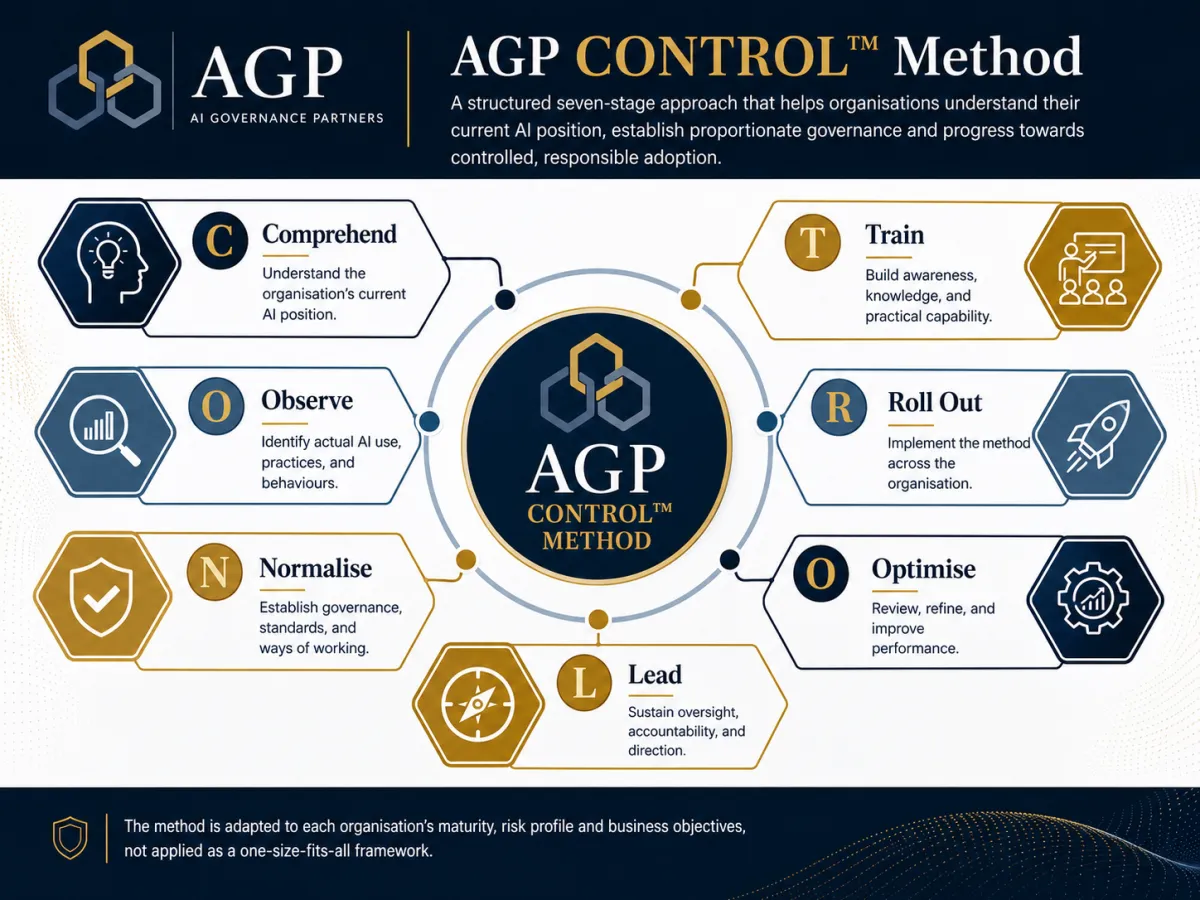
The method is founded on seven connected principles.
Comprehend. Before leadership can govern Artificial Intelligence, it must first understand where AI already exists within the organisation. This means identifying existing tools, understanding how they are being used and recognising the extent of informal or unapproved AI adoption.
Observe. Visibility alone is not enough. Leadership must evaluate the opportunities AI presents alongside the operational, legal, commercial and reputational risks that accompany them. This stage transforms information into understanding and enables informed executive decision-making.
Normalise. Governance should not restrict innovation; it should provide consistency. This stage establishes the policies, responsibilities, approval processes and decision-making principles that allow Artificial Intelligence to become part of normal business operations rather than an uncontrolled exception.
Train. Successful AI governance depends on people rather than technology. Leaders, managers and employees require a common understanding of how Artificial Intelligence should be used, where its limitations exist and why human judgement remains essential.
Roll Out. Once governance is established, organisations can introduce AI confidently through controlled pilot projects, approved use cases and measured implementation rather than fragmented experimentation.
Optimise. AI adoption is not a one-time project. Organisations should continually evaluate performance, measure business value, monitor governance effectiveness and refine both technology and operating practices as experience grows.
Lead. Executive leadership remains the constant throughout the journey. Governance is sustained through oversight, accountability and continual improvement, ensuring that Artificial Intelligence continues to support organisational objectives rather than gradually developing beyond them.
The AGP CONTROL™ Method is not intended to replace existing management systems. It complements them by providing a structured approach specifically designed for the unique governance challenges created by Artificial Intelligence.
Its purpose is simple.
To ensure that organisations adopt Artificial Intelligence with confidence while leadership remains firmly in control.
5. Putting the AGP CONTROL™ Method into Practice
Every organisation begins its AI journey from a different position.
Some have deliberately invested in Artificial Intelligence as part of a defined digital strategy. Others are only beginning to explore its potential. Many occupy a position somewhere between the two, where AI has gradually entered the organisation through individual initiatives rather than coordinated leadership.
For this reason, there is no universal starting point.
An organisation cannot simply download a policy, appoint an AI lead or purchase a software platform and assume that governance has been established. Effective governance begins with understanding the organisation as it exists today, not as leadership assumes it exists.
The AGP CONTROL™ Method is therefore designed as a progressive management journey rather than a compliance exercise. Each stage creates the foundation for the next, ensuring that decisions are based on evidence instead of assumptions.
The first priority is always visibility.
Before discussing governance structures or investment decisions, leadership needs an accurate understanding of how Artificial Intelligence is already being used throughout the organisation. This includes identifying approved AI systems, understanding informal adoption, recognising Shadow AI activities and establishing where AI is already influencing operational or commercial decisions. Without this visibility, every subsequent decision is based on incomplete information.
Once the current position is understood, leadership can begin evaluating what those findings mean for the organisation. Some uses of AI may represent significant opportunities to improve efficiency, quality or customer service. Others may expose confidential information, create contractual uncertainty or introduce unacceptable operational risks. Effective governance does not treat every AI application in the same way. It distinguishes between beneficial innovation and unmanaged exposure, allowing leadership to focus its attention where it adds the greatest value.
Only after this understanding has been established does governance become meaningful.
Policies, approval processes, accountability, acceptable use requirements and management responsibilities are no longer theoretical documents prepared in anticipation of future AI adoption. They become practical responses to the organisation's actual operating environment. Governance evolves from evidence rather than assumption, making it more relevant, easier to implement and more likely to be accepted by the people expected to apply it.
The next stage focuses on people.
Artificial Intelligence does not make decisions independently of an organisation; people decide when, where and how AI is used. For that reason, governance succeeds only when employees understand both the opportunities and the responsibilities associated with AI. Training is therefore not an isolated activity delivered after implementation. It is an essential component of governance itself, ensuring that leadership, managers and employees share a common understanding of expectations, limitations and accountability.
Only when these foundations are established should organisations begin expanding the operational use of Artificial Intelligence.
Rather than encouraging unrestricted experimentation, the AGP CONTROL™ Method advocates controlled implementation through clearly defined pilot projects, measurable objectives and structured review. This approach allows organisations to gain practical experience, demonstrate measurable business value and refine governance before AI becomes embedded across larger parts of the business.
The final stages recognise that Artificial Intelligence is not a destination but a continuously evolving capability.
New technologies will emerge. Existing platforms will introduce additional functionality. Regulatory expectations will continue to develop. Business priorities will change. Governance must therefore evolve alongside the organisation rather than remaining fixed at the point of implementation.
Leadership remains responsible for maintaining that evolution through continual oversight, periodic review and a commitment to continuous improvement. In this respect, AI governance should be viewed no differently from quality management, information security or health and safety. It is not a project with a completion date. It is an organisational capability that develops over time.
The value of the AGP CONTROL™ Method lies in its ability to provide a structured path through that evolution. It enables organisations to move deliberately from uncertainty to understanding, from isolated experimentation to coordinated adoption and from reactive governance to sustained executive confidence.
Ultimately, the method is not about governing technology.
It is about ensuring that leadership retains confidence in the decisions made by the organisation, regardless of how rapidly Artificial Intelligence continues to evolve.
6. The Leadership Conversation Every Board Should Have
Every board periodically reviews financial performance, operational risk, cybersecurity, health and safety, regulatory compliance and strategic direction. These conversations are fundamental because they enable leadership to understand whether the organisation remains aligned with its objectives and whether emerging risks are being managed appropriately.
Artificial Intelligence deserves the same level of executive attention.
Not because AI represents an unavoidable threat, but because it is rapidly becoming part of the way organisations create value, make decisions and interact with customers, suppliers and regulators. Like any significant organisational capability, it requires leadership to ask the right questions before assuming the right answers.
Those questions need not be complex.
Leadership should first ask whether it genuinely understands how Artificial Intelligence is currently being used throughout the organisation. This extends beyond formally approved systems to include departmental initiatives, publicly available AI platforms, supplier practices and any other activities that may influence business outcomes.
The next question concerns accountability. Has the organisation clearly defined who is responsible for governing Artificial Intelligence, or has responsibility become dispersed across multiple functions without clear ownership? Effective governance depends upon leadership knowing where accountability begins and where it ultimately rests.
Boards should also consider whether employees have sufficient guidance to make informed decisions. Are they expected to determine appropriate AI use independently, or has leadership established clear principles that encourage innovation while protecting the organisation's interests? The absence of guidance does not eliminate risk; it merely transfers decision-making to individuals who may lack the broader organisational perspective.
Relationships with external providers deserve similar attention. Increasingly, suppliers, consultants and service providers rely on Artificial Intelligence as part of their own operations. Leadership should therefore understand not only how AI is used internally but also how it may influence services delivered on the organisation's behalf.
Finally, executive teams should ask themselves a question that lies at the heart of the AGP CONTROL™ Method:
Can we demonstrate that leadership remains in control of Artificial Intelligence, or are we simply assuming that we are?
There is no expectation that every organisation will have reached the same level of maturity. Nor should organisations delay innovation until every uncertainty has been resolved. The objective is not perfection. The objective is informed leadership.
The organisations that will succeed in the coming years will not necessarily be those that deploy the most advanced AI technologies. They will be those whose leadership understands the organisation's AI landscape, makes informed decisions and creates an environment where innovation can flourish without compromising accountability, trust or good governance.
That is, ultimately, what the AGP CONTROL™ Method seeks to achieve.
Continue Reading:
Legal AI: Opportunity without Governance can become a liability
Implementing AI in your business? A Guide to Infrastructure and Cloud Solutions
AI and Hazard Observation Card Analytics: A deep, comprehensive exploration
About the Author
Massimo Brebbia is the founder of AI Governance Partners, a UAE-based executive and AI governance adviser with more than 30 years of leadership and operational experience across complex, regulated and international industries. Read Massimo’s profile →
Author’s Note
This article reflects my professional judgement and, where relevant, first-hand experience in leadership, technology implementation and AI governance. AI tools were used to support research, fact-checking, language refinement and grammatical accuracy. The arguments, interpretations, conclusions and opinions are my own, and I remain responsible for the final content. Publicly available research and primary sources are cited where applicable.