
The AI Witch Hunt Has Started, and It Is Asking the Wrong Question
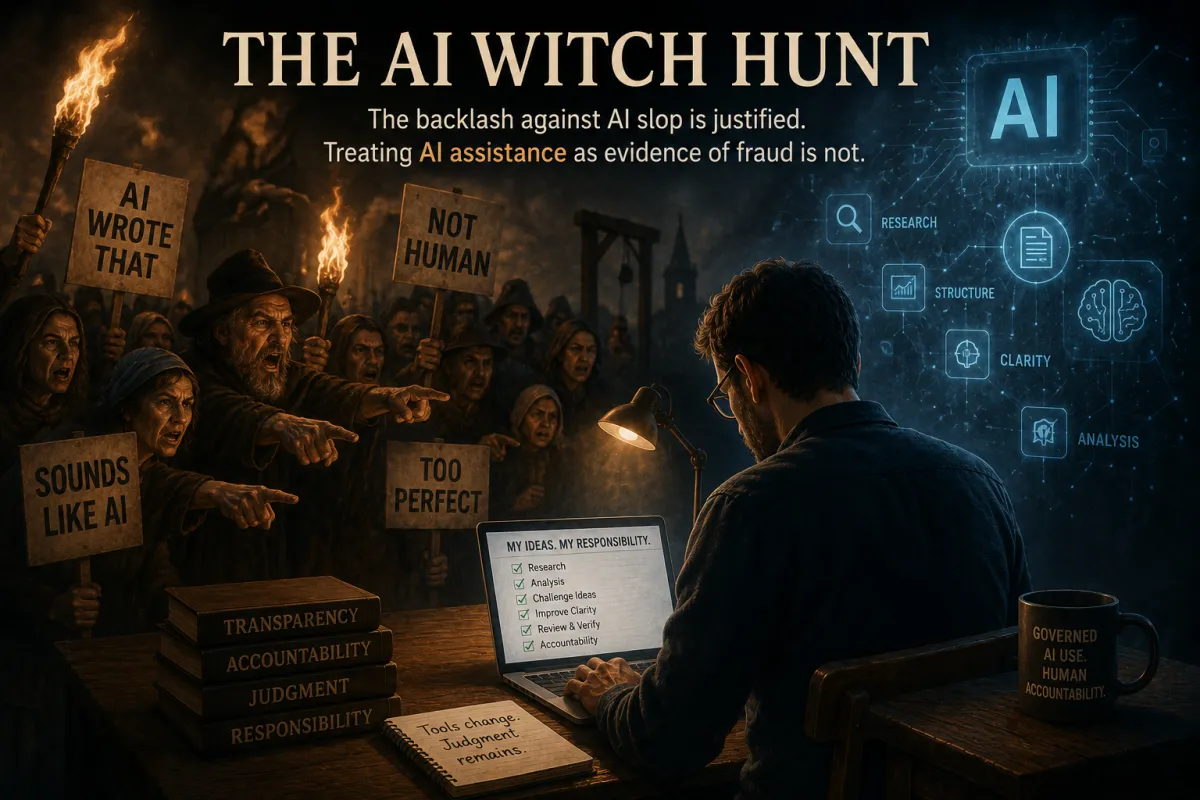
By Massimo Brebbia - 5 min read - Published 26 Aug 2026
Something has changed remarkably quickly in the conversation around artificial intelligence.
Not long ago, organisations were encouraging employees to experiment with generative AI. Technology companies were integrating it into productivity applications. Executives were discussing adoption, efficiency and competitive advantage.
Now another conversation is taking place.
Did AI write this?
Was that article really written by the person whose name appears above it?
Is that unusually polished sentence evidence of ChatGPT?
What about an em dash?
Across social media, publishing and professional communities, suspicion about AI-generated content is increasing rapidly. In August 2026, Quartz went as far as describing the backlash against AI writing as a developing “witch hunt” and I think there is some truth in that description.
But there is also a genuine problem behind it, and that distinction also matters to me.
AI slop is real; we should not pretend that the concern appeared without reason. It is a fact that generative AI has dramatically reduced the cost of producing words, images, comments and videos. A person can now generate in minutes a quantity of content that would previously have required days of work. I do it too. But the problem is that the result has been an enormous increase in low-effort content.
LinkedIn has openly acknowledged the problem. In May 2026, the company said it was seeing increasing amounts of what has become known as “AI slop”: AI-generated material that may appear polished but contributes little original perspective or substance.
In July, LinkedIn went further and introduced a “Seems like AI slop” reporting option.
The response demonstrates how strongly users feel about the issue. Within weeks, the feature had reportedly been used more than one million times. I don't want to enter into another discussion where people are less interested in the content, but more interested in discrediting an author just because they have used AI to make it sound better.
There is also some data supporting the perception that AI-generated writing has become widespread.
In July, AI-detection company Pangram published an analysis based on more than one million social-media posts encountered through users of its browser extension. It reported that more than 40% of LinkedIn posts longer than 250 words in its dataset were classified as fully AI-generated.
That is an extraordinary number. It also needs to be interpreted carefully.
The dataset was generated through users of Pangram's own extension rather than through a random sample of everything published on LinkedIn. The result therefore should not be interpreted as establishing that precisely 40% of all long-form LinkedIn posts are AI-generated.
Nevertheless, the broader conclusion is difficult to dispute.
AI has made it possible to generate enormous volumes of professional-looking material with almost no meaningful human contribution.
That creates a real quality problem. I do not think we should defend it, but AI slop and AI-assisted work are not the same thing
This is where I believe the discussion is beginning to go wrong, and is a mindset matter. We are gradually replacing the question:
“Is this valuable, authentic and accountable?”
with a much simpler question:
“Was AI used?”
The most astute among you already understood that those are not equivalent questions.
Let's see if I can make it clearer with a practical example: consider two people writing an article.
The first asks an AI system to write 1,500 words about a subject they know little about. They copy the result, perhaps change a few sentences, and publish it under their name without verifying the sources.
The second has substantial experience in the subject. They develop the argument themselves, use AI to research opposing viewpoints, locate information, test their reasoning, improve the structure and refine the English. They verify the important factual claims, reject suggestions they disagree with and take responsibility for the final article.
Both have used AI.
From a governance perspective, however, they have done completely different things.
The first has effectively delegated authorship and judgment.
The second has used a tool.
Collapsing both activities into the category of “AI-written” removes precisely the distinction we should be interested in.
We are beginning to confuse detection with evidence.
The situation becomes more complicated when AI detectors enter the process.
Substack introduced AI-text detection in July 2026 through a partnership with Pangram. Readers can now analyse certain posts, notes and comments and receive an estimate of how much appears human-written or AI-assisted.
The word estimate is important.
Substack itself provides authors with mechanisms to report detection errors and allows detection to be disabled on individual posts.
Pangram reports extremely strong performance for its latest models, including a very low false-positive rate. Those claims deserve to be considered seriously.
But an AI detector is still making an inference from the characteristics of a finished piece of text.
It did not watch the author write.
It does not possess the document's complete intellectual history.
It does not know which ideas existed before the author opened an AI application, which paragraphs were rewritten twenty times, which suggestions were rejected or which facts were independently verified.
It examines the output and estimates its origin.
That can be useful information.
It should not automatically become a verdict.
There is historical reason for caution. A Stanford study published in 2023 tested several AI detectors against essays written by non-native English speakers and found that 61.22% of the human-written TOEFL essays examined were classified as AI-generated.
Detection technology has developed considerably since that research, so it would be wrong to apply those figures directly to today's systems.
But the governance lesson remains highly relevant, and this is the part that interests me the most.
A probabilistic indicator should not quietly become proof of misconduct.
Particularly when reputations, employment, academic results or professional credibility may depend on the conclusion.
We are even changing human writing to make it look less like AI
Perhaps the strangest consequence of the backlash is that people are beginning to alter genuine human writing because they are afraid it looks artificial.
The em dash has become one of the more amusing examples.
For generations it has been an entirely normal piece of punctuation. Writers used it long before generative AI existed.
But because contemporary language models also use it frequently, the em dash has acquired a strange new reputation as an indicator of AI-generated prose.
Human writers have publicly discussed avoiding it because they do not want their work accused of being generated by a machine.
Think about the irony.
Large language models were trained extensively on human writing.
They learned patterns from us.
Now we are identifying some of those same patterns in human writing and concluding that the humans must be imitating the machines.
At some point, detection becomes circular.
The same applies to structured paragraphs, certain transitions and polished grammar.
If good writing begins to look suspicious simply because AI has learned to reproduce characteristics of good writing, we have created an extraordinary incentive:
people may deliberately make their work worse in order to demonstrate that it is human.
That cannot be the outcome we want.
There is not even an agreed definition of acceptable AI assistance.
Recent events demonstrate another problem. Professional organisations have not reached a common view on where legitimate assistance ends and unacceptable authorship begins.
In August 2026, the Financial Times issued a clarification after discovering that AI had been used to condense a longer draft of an opinion article before submission. The FT stated that this breached its editorial code, which prohibits AI use in the writing process.
A few days later, a very different position emerged.
Investor Stanley Druckenmiller confirmed that he had used AI while preparing an opinion article published by The Wall Street Journal.
The Journal defended the publication.
Its editorial-page editor argued, in substance, that AI assistance did not invalidate Druckenmiller's authorship because the arguments represented his genuine views and he remained responsible for them.
Neither organisation is necessarily being irrational.
They have different editorial standards.
And that is exactly the point.
There is currently no universally accepted boundary defining appropriate AI assistance in professional writing.
If sophisticated international publications can legitimately establish different rules, we should be cautious about allowing an anonymous social-media user armed with an AI detector to establish the rule for everyone else.
This is where governance provides a better answer; I advocate for this strongly.
Governance begins by defining the activity we are trying to control.
If the objective is to prevent low-quality automated content, then control low-quality automated content.
If the objective is to ensure transparency, define when disclosure is required.
If the objective is to protect confidential information, control what data may enter an AI system.
If the objective is to preserve professional accountability, define who must review and approve the output.
If the objective is to protect intellectual property, establish rules governing source material and generated content.
But, in my opinion, simply asking whether AI was involved tells us remarkably little.
I want to challenge your intellect; imagine applying the same standard elsewhere.
If an engineer uses simulation software, we do not ask whether the computer performed the calculations and then conclude that the engineering judgment is fraudulent.
If a finance director uses Excel, we do not decide that the financial analysis has ceased to be theirs.
If an executive employs a speechwriter, editor or research assistant, we do not automatically assume that the ideas expressed no longer represent the executive.
The relevant questions are about control, competence, transparency and accountability.
AI should not somehow eliminate those distinctions. The question should be: who is accountable?
For me, there is a simple test:
When somebody publishes AI-assisted professional work, can they explain and defend it?
Can they explain why they reached the conclusion?
Can they identify the important sources?
Can they distinguish fact from interpretation?
Can they recognise an error if challenged?
Can they explain how AI contributed?
And are they prepared to accept responsibility for the final result?
If the answer is yes, there is still a human exercising judgment.
If the answer is no, the problem is much deeper than writing style.
The human has become little more than the delivery mechanism for an AI output.
That is precisely the situation good governance should prevent. AI literacy should include knowing when not to trust AI, and with this argument I am trying to defend unrestricted AI use. Quite the opposite.
Responsible AI use requires more work than simply copying a generated answer.
It requires understanding the limitations of the tool, verifying important claims, protecting sensitive information, recognising situations where AI should not be used and knowing when human expertise must take precedence.
It also means resisting the temptation to publish simply because generating content has become easy.
AI has reduced the cost of producing words; it has not reduced the value of having something worth saying.
In fact, I think it has increased it.
When everybody can produce competent-looking text almost instantly, expertise, experience, judgment and original perspective become more valuable, not less.
Those are the scarce resources.
The words are becoming the inexpensive part.
We should fight the slop, not the tool
I therefore understand the backlash. I understand why LinkedIn wants to reduce mass-generated posts and automated comments, and I understand why readers become frustrated when apparently thoughtful content turns out to contain no thought at all.
I also understand why publishers want to protect trust between writers and readers.
Those objectives are legitimate.
But this is where I stop; the next step matters.
If we move from fighting low-quality automated content to treating any use of AI as suspicious, we will have converted a legitimate quality problem into an ideological purity test.
That is where the witch hunt begins.
The distinction we need is not:
Human versus AI. It is: Human judgment versus unaccountable automation. One can involve AI, the other can sometimes involve a human pressing “publish.”
Governance exists to understand the difference.
And as AI becomes integrated into Word, browsers, search engines, email, enterprise applications and everyday professional workflows, trying to maintain an artificial world in which technology has never touched the final product will become increasingly unrealistic.
The objective should not be to prove that AI was absent.
The objective should be to demonstrate that the human remained in control.
That is a much harder question.
It is also the one that actually matters.
Author's Note
AI tools were used in preparing this article to support research, challenge arguments, verify factual statements, organise information and refine language. The interpretation, opinions and conclusions are my own. I reviewed the final content and remain responsible for what is published.
That distinction is not hidden because it is precisely the point of this article.
This article is also published on Medium as part of my public research and writing.
Continue Reading:
Legal AI: Opportunity without Governance can become a liability
Implementing AI in your business? A Guide to Infrastructure and Cloud Solutions
AI and Hazard Observation Card Analytics: A deep, comprehensive exploration
About the Author
Massimo Brebbia is the founder of AI Governance Partners, a UAE-based executive and AI governance adviser with more than 30 years of leadership and operational experience across complex, regulated and international industries. Read Massimo’s profile →
Author’s Note
This article reflects my professional judgement and, where relevant, first-hand experience in leadership, technology implementation and AI governance. AI tools were used to support research, fact-checking, language refinement and grammatical accuracy. The arguments, interpretations, conclusions and opinions are my own, and I remain responsible for the final content. Publicly available research and primary sources are cited where applicable.